
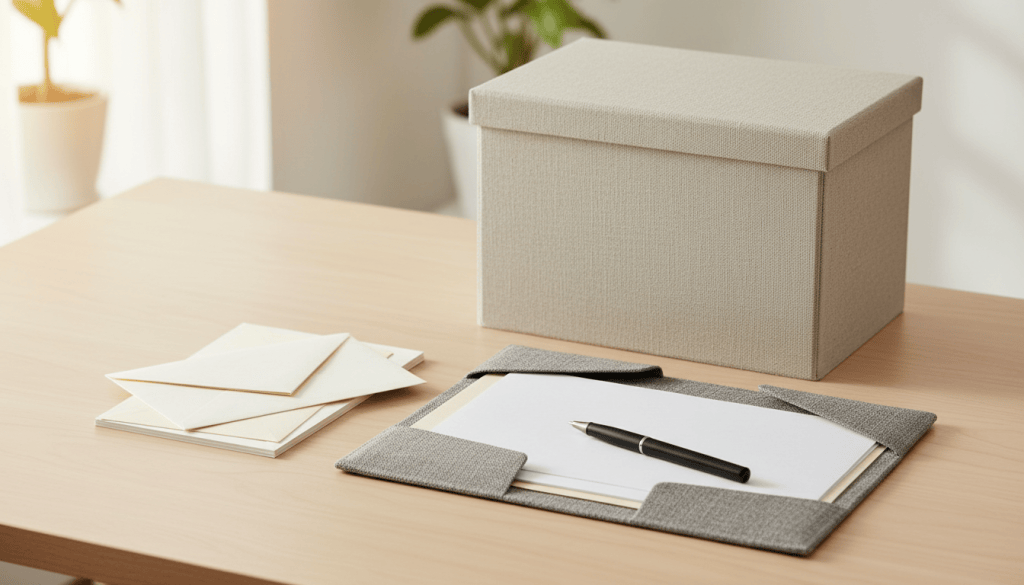
Household paperwork is easy to postpone because each piece seems small: a bill, a school form, a receipt, a notice, or a document to keep. The pile grows when every paper requires a decision about where it belongs. A simple system reduces those repeated decisions and makes the next step visible.

Give incoming papers one temporary landing place
Choose one inbox, folder, or tray for papers that need attention. It should be easy to reach when you come in and large enough for a short backlog, but not so large that papers can disappear inside it. Tell everyone in the household where incoming forms and notices should go.
Keep the inbox temporary. Its job is to collect papers until you review them, not to become long-term storage. If a paper arrives with a deadline, write the date on a calendar or task list as soon as you notice it, then put the document in the inbox for processing.
Sort into a few categories with clear next steps
During a short review, sort papers into simple groups such as “needs action,” “keep for reference,” and “recycle or shred.” You may want a separate place for important household records, but keep the categories broad enough that you can choose one quickly. A folder labeled “home” is often more useful than a complicated set of subfolders.
For papers that require action, add the next step: pay, sign, respond, file, or ask someone a question. If the task takes only a moment, you may be able to do it then. If it needs more time, record the step somewhere you already check. Grouping errands into one simple plan can help when a paper requires a trip or a return.
Store important records carefully and privately
Keep documents with personal, financial, or medical information somewhere private and protected from casual access. If you store digital copies, use an account and device you trust and make sure you know how to retrieve them. Follow the instructions from the organization that issued a document when a specific retention or submission rule applies.
Avoid keeping every paper just because you are unsure. Check whether it is still needed, whether a digital copy is sufficient for your situation, and whether the source gives guidance. For a shared household, agree on who is responsible for handling recurring forms and notices rather than leaving the responsibility implicit. That can reduce the mental load of remembering and planning.
Use a short review to keep the system working
Set a brief weekly or twice-monthly check that fits your schedule. Empty the inbox, note upcoming dates, file papers you truly need, and clear out the rest. If you miss a review, restart with the oldest or most time-sensitive items rather than trying to create a perfect archive.
Some recurring reminders—like birthdays, appointments, or renewals—may belong in a calendar rather than in a paper folder. A simple way to remember birthdays can move one kind of information out of the paper pile. Keep the system small enough that you can explain it in a sentence; if it takes a manual to use, simplify it.
Selected for this topic
Useful next reads
Four editorially reviewed guides chosen for relevance, not at random.
 Habits & decisionsHow to Make a Difficult Decision When You Keep Going Back and Forth
 Habits & decisionsHow to Tell Your Manager You Have Too Much Work: A Practical Plan
 Habits & decisionsHow to Restart a Habit After a Break: Resume, Resize, or Let It Go
 Habits & decisionsOverwhelmed by Laundry? How to Start When the Pile Feels Too Big