

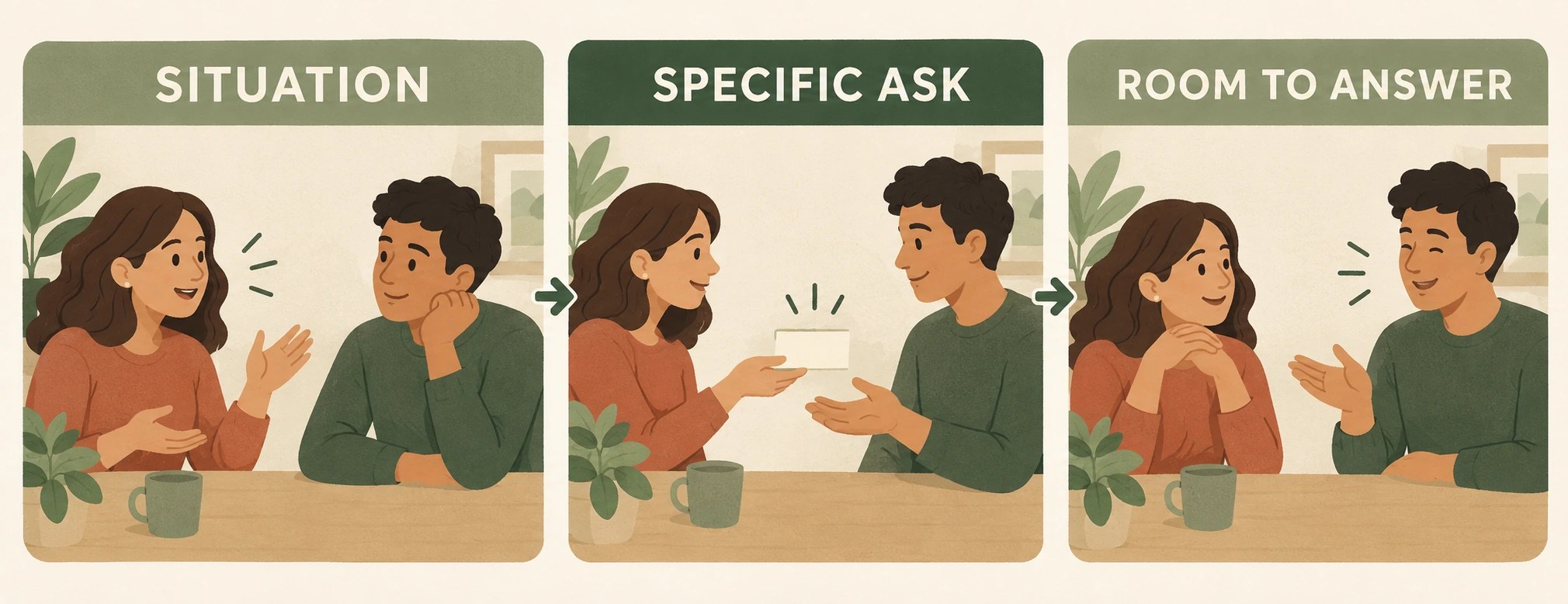
To ask for help, briefly name the situation, make one specific request, and say when or how much support you need. For example: “I’m sorting out a move and could use help carrying boxes for an hour on Saturday. Would you be available?” A clear request gives the other person something concrete to answer—and leaves them room to say what they can do.
Decide what kind of help would actually help
“I need help” can mean a lot of things. Before choosing whom to ask, take a moment to name the kind of support you want. You may need someone to do a task, explain a step, think through options, or simply stay with you while you begin.
- Practical help: a ride, a meal, a second pair of hands, or help with one errand.
- Information: an example, a recommendation, or an explanation of the first step.
- Perspective: a short conversation to compare choices or check what you may be missing.
- Company: someone to sit nearby while you make a call or start a difficult task.
If you want someone to listen while you talk, say so directly. How to Ask a Friend to Listen Without Giving Advice covers that specific conversation. This guide focuses on making a practical request that another person can understand and answer.
Make the request small, clear, and easy to answer
A useful request has three parts: a little context, one action, and a time or amount. The visual below shows that sequence. You do not need to explain every detail before asking.
Give only the context they need
A sentence or two is often enough: “I have two versions of this presentation and I’m not sure which is clearer.” If you are not ready to share the whole story, you can say that. The request should make sense without requiring you to disclose more than you want.
Ask for one concrete action
Instead of “Can you help me sometime?”, try “Could you read the first page and tell me where you lose the thread?” A specific request helps both of you understand what yes would involve.
Name the time, effort, or choice
A time frame makes the ask easier to evaluate: “Would you have 15 minutes today?” or “Could you help me carry one shelf after work?” You can add an easy out without apologizing for asking: “If this week is full, no problem.” Then let the person answer.
Use words that sound like you
A short script can help when you feel stuck. Adapt the wording so it sounds natural in your relationship.
- For a practical task: “I’m behind on getting the room ready. Would you be able to help me sort the books for 30 minutes on Sunday?”
- For information: “I’ve tried the first two steps and got stuck at the handoff. Could you show me an example, then I’ll try the next one?”
- For perspective: “I’m choosing between two options. Could I talk them through with you for 15 minutes? I’m looking for questions, not a decision from you.”
- When you are unsure what you need: “I’m not sure what would help yet. Would you have time for a short conversation while I sort it out?”
If the request is work-related, keep the scope and timing especially clear. For example, if you need more time on a deliverable, this guide to asking for a deadline extension at work offers wording for that narrower situation.
Choose someone who can reasonably help
The person you care about most may not be the person best placed to answer this particular request. Consider who has the time, access, skill, or willingness you need. Asking the right person for one manageable thing can be more useful than asking several people vaguely.
If the request involves a skill or decision that requires professional knowledge, look for someone qualified to provide that specific guidance. A friend can still offer company or help you prepare questions, but they do not have to become responsible for solving the whole problem.
If they say no, keep the next step simple
A no may mean the timing, task, or person does not fit. You can say, “Thanks for letting me know,” and decide whether to ask someone else, make the request smaller, or choose another plan. If it would help, you can ask once: “Is there another time that might work, or someone else you’d suggest?”
The other person is allowed to have limits, and you are allowed to ask. Their answer gives you information about this request; it does not decide whether you were wrong to make it.
Follow up without turning help into a debt
When someone helps, thank them specifically: “Thanks for looking at the outline. Your note about the opening helped me see what was missing.” You do not have to promise an immediate favor in return. If you want to reciprocate, do it in a way that feels honest and manageable.
Asking for help is a communication skill you can practise in small ways. Start with one task, one person, and one clear sentence. The request can be modest; the goal is to make it possible for the other person to respond honestly.
Selected for this topic
Useful next reads
Four editorially reviewed guides chosen for relevance, not at random.
 Relationships & supportHow to Ask for Help Without Feeling Like a Burden
 Relationships & supportWhat Are Personal Boundaries? Examples for Everyday Situations
 Relationships & supportHow to Tell a Friend You Can’t Text All Day: A Kind, Clear Plan
 Boundaries & assertivenessAssertive vs. Aggressive Communication: How to Tell the Difference